Process guide
How Pasta Is Made
Processes vary
Nine stages
From raw material to packed product
Why it mattersProtein content and particle size of the semolina affect dough strength, colour and cooking quality.
Stage 01
Raw material selection
Choosing the wheat product that suits the pasta and the market.
Dried pasta is traditionally made from durum-wheat semolina, which gives a firm bite and holds its shape when cooked. Many producers also use refined wheat flour (maida) or blends to meet a price point, and specialty lines use millets, whole wheat or added vegetables. Food-safety requirements apply to every ingredient.
Why it matters: Protein content and particle size of the semolina affect dough strength, colour and cooking quality.
Stage 02
Flour or semolina preparation
Sifting, weighing and dosing the dry ingredients.
Semolina or flour is sieved to remove lumps and foreign matter, then weighed or continuously dosed into the mixer. Larger plants store raw material in silos and convey it automatically; smaller units often dose by hand from bags.
Why it matters: Accurate dosing keeps the water-to-semolina ratio — and therefore the dough — consistent.
Stage 03
Mixing and hydration
Water is added and absorbed evenly by every particle.
Water is mixed into the semolina until it is absorbed evenly. The target moisture depends on the raw material, the shape and the machine. Many industrial extruders mix under vacuum to remove air, which would otherwise create bubbles and a pale, weaker product.
Why it matters: Uneven hydration shows up later as white spots, cracks or inconsistent shapes.
Stage 04
Dough preparation
Kneading the crumbly mixture into a compact dough.
Pasta dough is far drier than bread dough. Inside the extruder barrel, a screw compresses and kneads the moist crumbs into a dense, uniform mass while building the pressure needed to push it through the die.
Why it matters: Temperature matters — excessive heat from friction can damage the gluten network.
Stage 05
Extrusion through a pasta die
The dough is forced through the die, which gives the pasta its shape.
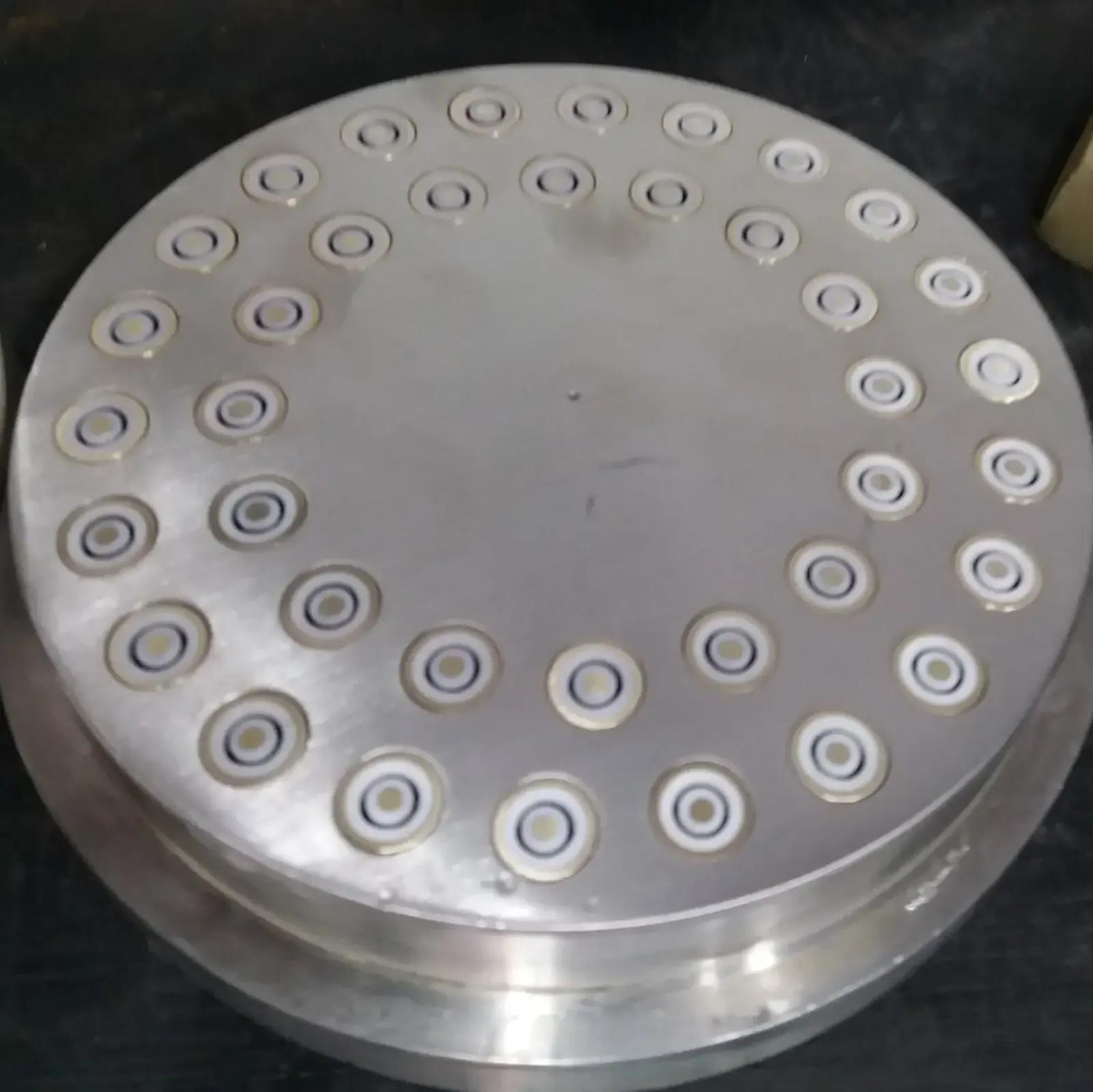
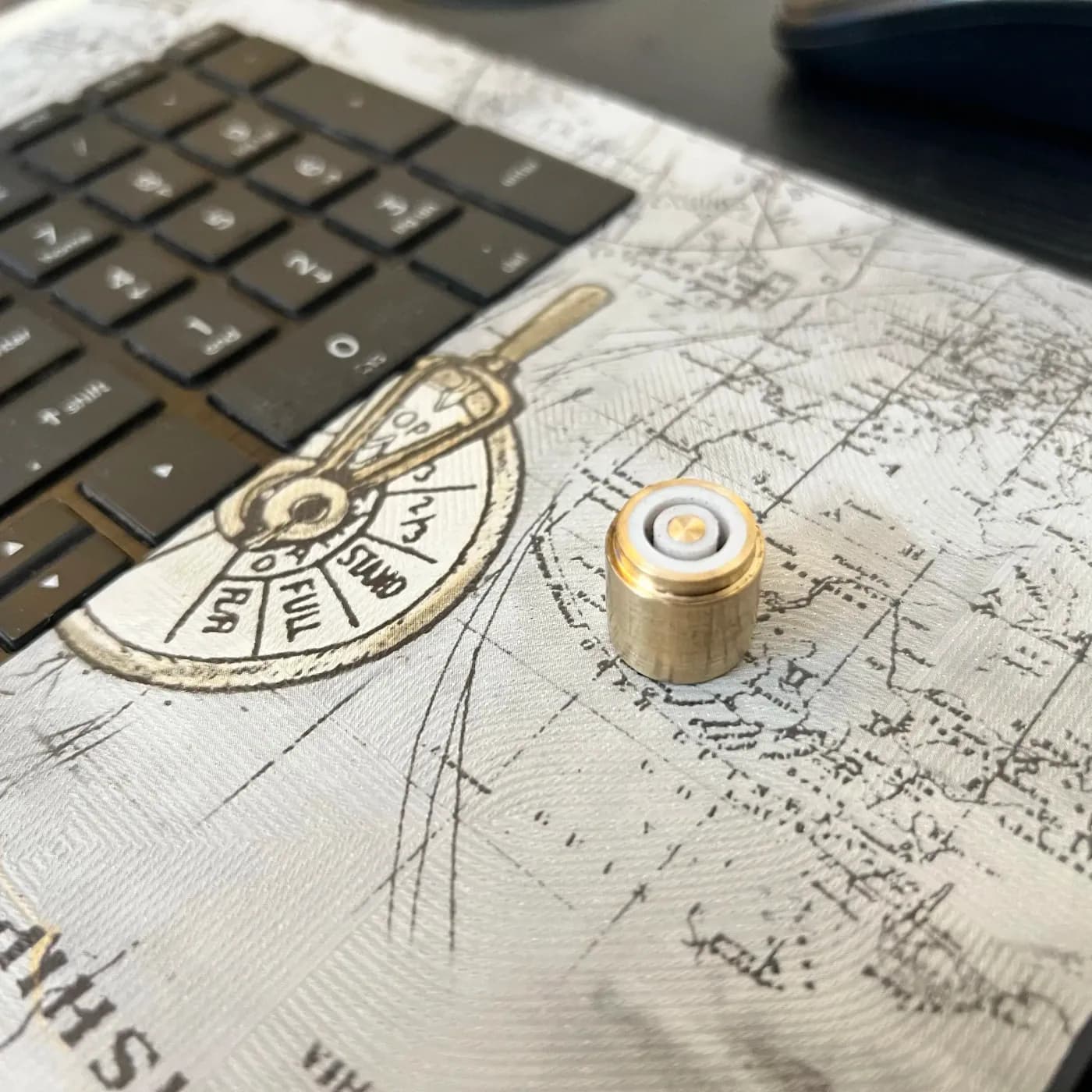
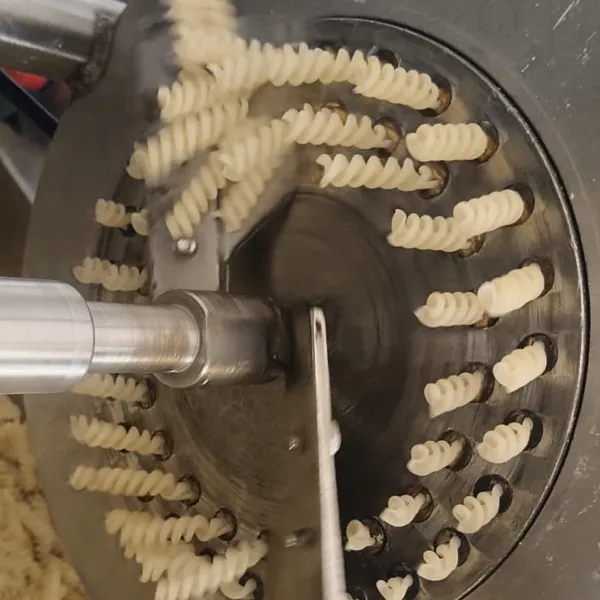
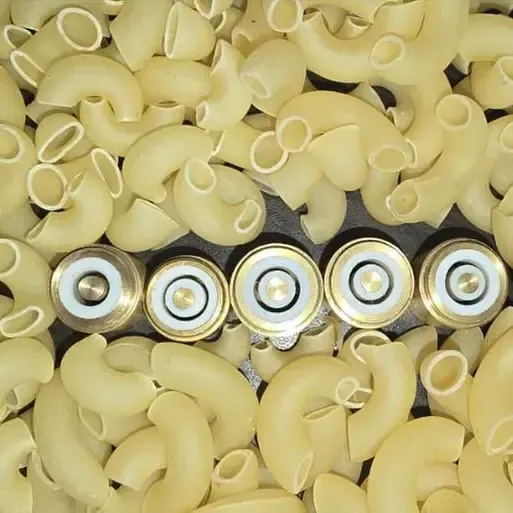
At the head of the extruder, the dough is pressed through the die. Each opening — often a replaceable insert — forms one strand. Pins create hollow tubes such as macaroni and penne; shaped channels twist dough into fusilli; plain round holes make spaghetti and vermicelli. The die material and lining influence the surface: PTFE (Teflon)-lined inserts tend to give a smooth, glossy finish, while bare metal such as bronze gives a rougher, matt surface.
Why it matters: The die must fit the extruder’s die seat and suit its pressure and output.
Stage 06
Cutting and shape formation
A rotating knife cuts the extruded strands to length.
For short shapes, a rotary knife sweeps across the die face and cuts the strands to length — square for macaroni, angled for penne. Knife speed relative to the extrusion speed decides the length of each piece. Long products such as spaghetti are hung on rods instead of being cut at the die.
Why it matters: Uniform length and clean cuts reduce breakage and give an even pack appearance.
Stage 07
Drying and moisture control
Moisture is reduced gradually to make the pasta shelf-stable.
Fresh pasta leaves the die with a high moisture content. A pre-dryer firms the surface so pieces do not stick, then the main dryer removes moisture gradually under controlled temperature and humidity. Drying too fast causes cracks and breakage; drying too slowly risks spoilage.
Why it matters: Final moisture must meet the applicable food standard for dried pasta and give a stable shelf life.
Stage 08
Cooling and quality inspection
The pasta is cooled, stabilised and checked.
After drying, pasta is cooled to room temperature so moisture does not condense inside the pack. Quality checks typically cover moisture, shape and size, colour, breakage, cooking behaviour and foreign matter, with records kept for each batch.
Why it matters: Consistent shapes depend on the die: worn inserts show up as variation at this stage.
Stage 09
Packaging and distribution
Weighing, packing, labelling and dispatch.
Pasta is weighed and packed into pouches, cartons or bulk bags, with labelling that meets food-labelling regulations. It is then dispatched to distributors, retailers, food-service customers or private-label clients.
Why it matters: Packaging cost per kg and pack sizes have a large effect on margins — see the profit calculator.
Die design
How dies determine pasta shape
Macaroni
A pin in the centre of each opening forms the hollow tube; a slight offset in the insert makes elbow macaroni curve as it leaves the die.
Penne
A pin forms the tube, and the rotary knife cuts it on an angle to create the angled ends.
Fusilli
Shaped channels in the die make the dough rotate as it is extruded, forming the spiral.
Spaghetti
Plain round openings form solid strands, which are hung and dried as long goods rather than cut at the die.
Vermicelli (sevai)
A perforated plate (jali) with many small holes forms very thin strands.
Extrusion systems
Extruder, die, inserts — and why they must match
The extruder doses, mixes and kneads the dough, then a screw builds pressure to push it out. Its output, pressure and die seat are fixed by its design.
The die must fit that die seat and clamping arrangement, and suit the pressure and output — a die that does not match can leak, wear unevenly or limit output.
Inserts are the replaceable forming elements in many dies. Their geometry sets size and wall thickness; a PTFE (Teflon) lining tends to give a smoother surface, bare metal a rougher one.
When ordering a die, share your machine make and model and die-seat dimensions — request a quotation.
Request a quotation
Need a die for your extruder?
Share your machine details, the pasta shape and your target output. R.N. will review your requirement and respond with options.